




Large FM providers are designed for enterprise-scale assets. Informal contractors offer no structure or accountability. The mid-market property owner is caught between them and paying for it, says Abdullah Showaib, Operations & Contracts Lead at SnapFixNow FMC.
June 03, 2026 | Staff Reporter | UAE | PropTech | 6 Min Read
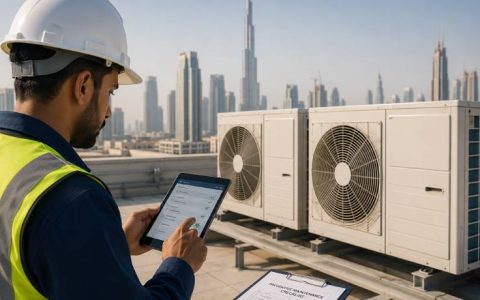
Preventive HVAC maintenance and documented facility management are becoming critical for Dubai property owners in 2026.
A single HVAC failure during a Dubai summer can cost a property operator more than a full year of scheduled maintenance when you factor in emergency call-out rates, urgent parts procurement, and the operational downtime that follows. Cooling systems in the UAE run for up to 8–10 months a year. That is not a system under occasional stress. It is a system under permanent load.
Yet the majority of mid-market properties in Dubai, residential towers, retail units, warehouses, still operate on a fix-when-broken model. Not because their owners don't know better, but because the FM industry has never properly served them.
The UAE facility management sector is forecast to reach USD 42.27 billion by 2031. The market is expanding. The service gap within it is also expanding.
At one end: large FM providers with enterprise technology platforms and contracts built around airports, government assets, and branded hotel groups. At the other: informal contractors who compete on day-rate pricing, offer no documented service agreement, and carry no accountability structure beyond a phone number.
The mid-market property owner — the landlord of a 40-unit residential tower, the operator of a retail strip, the investor managing a warehouse portfolio — fits neither profile. They are too small to be prioritised by enterprise FM, and too sophisticated to accept undocumented, unaccountable service. They need the discipline and documentation standards of the top tier, without the enterprise overhead and minimum contract sizes that come with it.
The structural problem is not maintenance. Most buildings have someone doing maintenance. The problem is verification.
In a properly managed building, every maintenance visit produces a job card recording what was inspected, what was found, what was corrected, and what requires follow-up. An asset register tracks the condition and service history of every piece of equipment. Together, these documents give the property owner proof, not a promise, that their asset is being managed.
In the majority of mid-market properties in Dubai, none of this exis
"Most buildings don't fail because of equipment;
they fail because no one verifies the maintenance"
This is an accountability gap. And it is costing mid-market property owners money, assets, and tenants. Reactive maintenance drains 30-50% more OPEX over a 24-month period compared to structured preventive programmes. A poorly maintained HVAC system consumes 15–30% more energy to achieve the same output.
The most significant change emerging in Dubai's mid-market FM sector is not a new technology or a new service offering. It is a change in what property operators are demanding from their maintenance partners: not activity, but evidence.
This shift is being driven by three converging pressures. First, rising insurance and compliance requirements are pushing landlords to document building condition and maintenance history — insurers are increasingly denying claims where no verified maintenance record exists. Second, tenant expectations in mid-to-high-end residential have elevated rapidly, and lease non-renewals increasingly cite maintenance responsiveness as the deciding factor. Third, the cost data is now accessible enough that building operators can see, sometimes for the first time, what reactive maintenance is actually costing them over a two-year horizon.
The result is a growing segment of mid-market property owners who know what accountable FM looks like and are no longer finding it from either enterprise providers or informal contractors.
The FM contract model emerging in response is the SLA-driven Annual Maintenance Contract with documented PPM schedules, photo job cards, and a named accountable contact. It is not new in concept. It is new in availability to the mid-market segment.
For property operators evaluating their options, a credible FM partner delivers five things: engineering-led scheduling against asset condition; photo-documented evidence at every visit; SLA-backed response commitments defined in the contract; a named person who answers, not a call centre; and documentation built to satisfy both insurance requirements and UAE regulatory inspection standards.
These are not premium add-ons. They are the baseline standards that define whether an FM relationship is actually protecting a building.
In a mid-market residential building in Al Barsha, a landlord operating on a reactive model was experiencing recurring HVAC failures, escalating tenant complaints, and no documented maintenance history. After transitioning to a structured 12-month AMC with monthly PPM visits, photo-documented job cards, and an asset register built from the first site survey, the results within 90 days were measurable:
No new equipment was installed. No staff were added. The only change was structure: scheduled visits, documented outcomes, and a single accountable contact who knew the building's asset history from day one.
Dubai's FM industry is not short of providers. What it has lacked, for mid-market property operators specifically, is a category of service that combines the documentation standards and engineering discipline of the enterprise tier with the responsiveness, named accountability, and flexible contract structure that smaller portfolios require.
The SLA-driven AMC model, built around photo-documented job cards, asset registers, and a named operations lead on every engagement, is not built around dashboards or enterprise reporting platforms. It is built around one principle: that a property owner should always be able to answer the question 'what maintenance was done on my building this month' with evidence.
"Dubai's FM industry was built for enterprise clients.
Mid-market property owners were never the priority.
That is changing"
For Dubai's mid-market property operators, that answer has, for too long, been unavailable. That is the gap the market is now beginning to fill.
About the Author
Abdullah Showaib is Operations & Contracts Lead at SnapFixNow™ FMC, a Dubai-based technical facility management company specialising in SLA-driven Annual Maintenance Contracts across residential, retail, and industrial properties. The company is known for engineering-led maintenance, full documentation standards, and a single accountable point of contact on every contract.
About SnapFixNow
For property operators, SnapFixNow FMC offers a free site survey and asset register for qualifying properties across Dubai. Engagements begin with a no-obligation consultation and a BOQ-backed proposal delivered within 30 days.
Contact:
Abdullah Showaib
operation@snapfixnow.com
+971 50 500 8186
www.snapfixnow.com