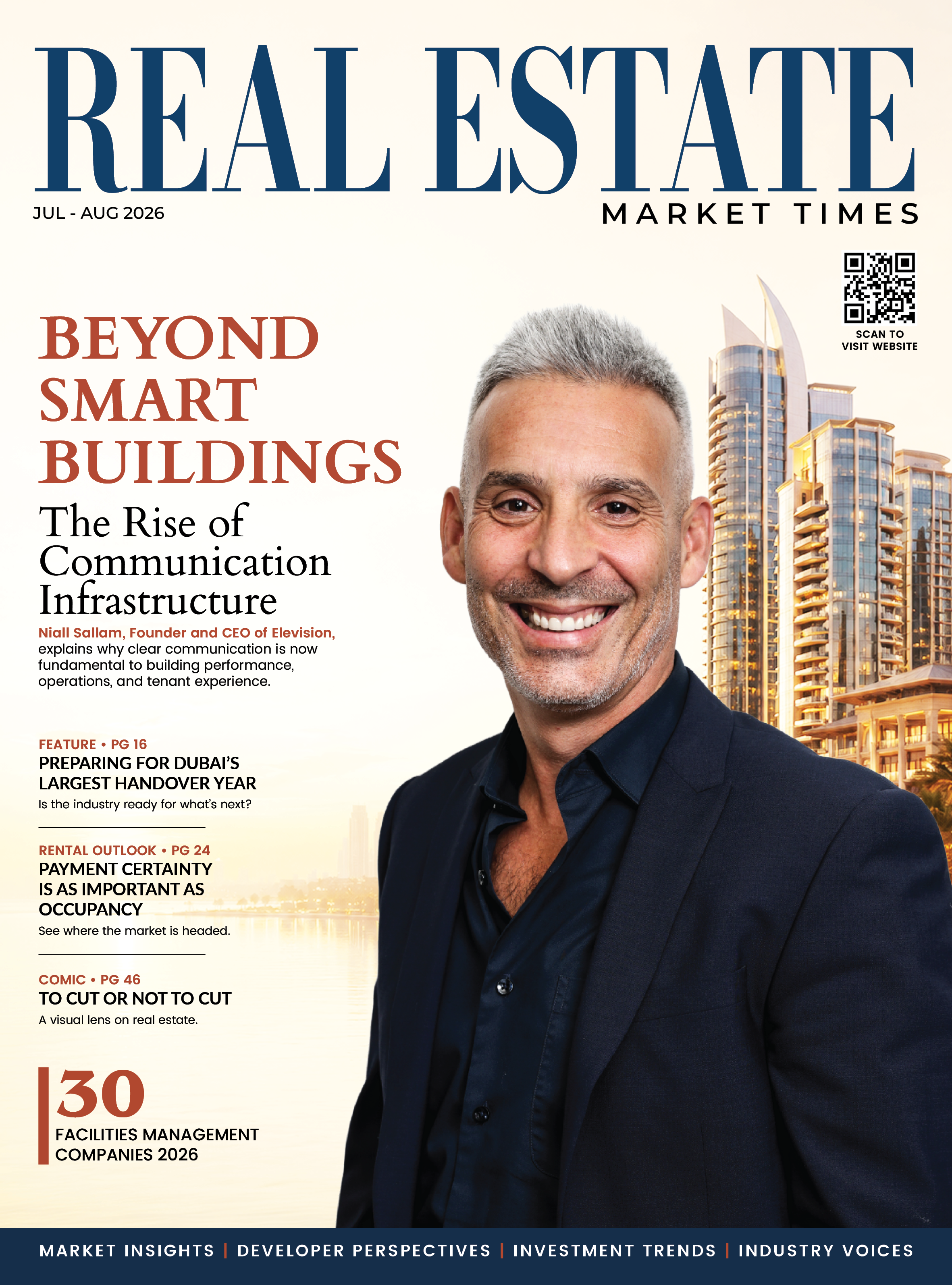





As buildings become more complex and continuously occupied, how they communicate is still widely overlooked, directly impacting operations, experience, and long-term performance. Niall Sallam, Founder and CEO of Elevision, explains why digital communication is increasingly being treated as core infrastructure rather than an afterthought.
August 26, 2026 | Tripti Mehta | UAE | PropTech | 6 Min Read

Modern buildings are no longer defined solely by their architecture or amenities, but by how effectively they operate on a daily basis. As assets become denser, more mixed-use, and continuously occupied, the ability to communicate clearly with the people inside them has shifted from convenience to necessity. Yet, across much of the industry, communication remains fragmented, treated as messaging rather than as a system.
This disconnect is increasingly visible. When information is unclear or delayed, friction follows; tenant dissatisfaction rises, operational pressure increases, and perceptions of asset quality begin to erode. In this context, communication is no longer peripheral to performance. It is part of how a building functions.
From the perspective of Niall Sallam, Founder and CEO of Elevision, this remains a structural blind spot across much of the real estate industry. Digital communication, he argues, has long been treated as a marketing layer or operational afterthought rather than a system designed into the asset itself.
“Once communication is planned properly and embedded,” he says, “it stops being something you manage reactively and becomes something the building relies on.”
Elevision’s evolution reflects that shift. What began as a digital screen network has developed into a shared communication layer integrated into lifts, lobbies, and communal areas — locations defined not by visual prominence, but by relevance and frequency of use. Over time, these screens became part of a building’s operational rhythm rather than a competing source of attention. Alongside essential building updates, curated lifestyle, art and culture programming gives residents relevant content connected to their community, helping the screens become a valued part of the shared environment.
The inflection point was behavioural. Building teams increasingly relied on the screens, managed through CommConnect, Elevision’s real-time tenant communication platform, as the most immediate way to communicate changes. Residents, employees, and visitors began referencing them instinctively. Communication moved from being incidental to being functional.
Communication as Infrastructure
When communication is treated as infrastructure rather than messaging, its value is first experienced by the people who live and work within the building. Clear, timely information helps residents and occupants feel informed, reassured, and more connected to their environment. For asset owners and investors, this stronger experience reduces friction, supports satisfaction, and reinforces confidence in management quality. Buildings that communicate clearly tend to feel calmer, more intentional, and better run, strengthening their long-term competitiveness.
This impact typically appears in three areas:
• Experience consistency, where occupants feel informed rather than managed
• Operational clarity, reducing misunderstandings and reliance on frontline staff
• Asset perception, reinforcing professionalism, care, and long-term intent
“There’s a persistent assumption that more communication leads to better outcomes,” Sallam notes. “In reality, most buildings don’t have a volume problem. They have a clarity problem.”
Screens, however, are only as effective as the discipline behind them. In private living and working environments, the margin for error is narrow. Elevision’s approach prioritises relevance and restraint, recognising that the most effective communication often draws the least attention to itself.
“Good building communication is quiet and useful,” Sallam adds. “If it needs to shout, it’s usually doing the wrong job.”
This philosophy extends to privacy and governance. Elevision does not track individuals or collect personal data. All content uses non-PII data and is fully GDPR compliant, and operates within frameworks agreed with building owners and managers. Oversight remains firmly with asset stakeholders, ensuring communication remains appropriate to its environment.
“If residents or tenants feel uncomfortable,” Sallam says, “then the system has failed, regardless of commercial outcomes.”
Insert image: https://drive.google.com/file/d/18yPdaSBsCVtwZIePzb2_2jw44ErMUQfv/view?usp=share_link
Trust and Context at Scale
As Elevision has expanded across cities, districts, and mixed-use environments, maintaining contextual relevance has become increasingly complex.
Every building carries its own expectations and sensitivities. Scaling a communication network without eroding trust requires local understanding and discipline, not uniform deployment. This approach is reflected in Elevision’s work across major urban districts including Dubai International Financial Centre, Dubai Design District, One Central, and in partnerships spanning premium mobility infrastructure through Skyports, alongside collaborations with leading developers, property managers, and government entities.
“Sustainable growth isn’t about applying the same solution everywhere,” Sallam explains. “It’s about maintaining quality while respecting context. That becomes harder as you scale, but it’s also where credibility is built.”
At scale, Elevision’s model depends on:
• Local sensitivity, adapting communication to building type and audience
• Governance, ensuring owners retain oversight and control
• Restraint, recognising that usefulness matters more than visibility
The same thinking shapes how Elevision positions itself alongside PropTech platforms and community apps. Rather than competing for attention, the systems are designed to complement one another. Screens provide shared awareness and timely prompts; apps deliver depth and action. Used together, they simplify communication rather than multiply channels.
Sallam says his belief in communication as infrastructure has strengthened as the industry has begun to look more seriously at how buildings perform over time. That thinking was echoed in discussions he took part in during World Realty Congress 2025, where the focus moved beyond delivery cycles toward experience, resilience, and long-term asset behaviour. For him, those conversations reflected a growing consensus that buildings are increasingly active environments, shaped by the systems embedded within them early on.
“When you’re designing for decades rather than development cycles,” he says, “communication stops being an afterthought and becomes essential infrastructure.”
Looking ahead, Elevision’s focus remains on large, mixed-use environments designed for longevity rather than launch impact. These districts operate across extended hours, serve multiple audiences, and evolve continuously, placing far greater demands on communication systems than single-use assets.
As cities grow denser and buildings more dynamic, communication is no longer peripheral to real estate performance. It is increasingly part of the structure itself, considered, governed, and essential to how places function.
At a GlanceNetwork Scale Markets Environments Served |