




Why Dubai’s real estate doesn’t just survive pressure, it’s designed for it.
April 17, 2026 | Tripti Mehta | UAE | Developers | 9 Min Read
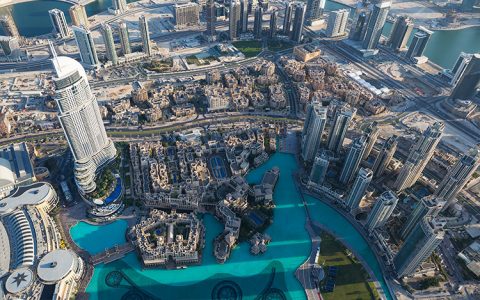
The question was posed sharply in early 2026. Global macro conditions tested every market at once, Ramadan compressed working hours and decision cycles, and capital had every reason to pause. Real estate markets in proximity to instability typically signal it immediately via falling volumes and retreating foreign interest. Dubai, however, did not pause. Buyers transacted, developers launched, and investors committed. The question worth asking is not whether the market is resilient. It is what, precisely, makes it so.
The market that entered 2026 did so from a position of exceptional strength. The Dubai Land Department’s annual performance statement confirms 2025 as the sector’s strongest year on record, with over 270,000 transactions worth AED 917 billion. But the strength of a market is not only measured in its record years. It is measured in how it behaves when tested. The conditions of early 2026 provided that opportunity to demonstrate exactly that. The reason Dubai passed it lies in six structural mechanisms, each deliberately built, each quietly reinforcing the others.
The Selectivity Buffer
The first mechanism is counterintuitive: Dubai’s resilience is partly a function of what the market doesn’t do when pressure arrives. It doesn’t flood supply. It doesn’t capitulate on pricing. Instead, demand reorganizes by shifting toward well-credentialed developers and well-located projects, while developers respond with phased launches and controlled supply rather than desperate volume plays.
Dr. Majid Jack Hsiung, General Manager at Source of Fate, describes the dynamic precisely. “Demand does not disappear; instead, it shifts toward well-located, thoughtfully designed projects. Pressure is managed through transaction pacing, buyer behaviour and developer strategy, with developers like us phasing launches, controlling supply and structuring payments,” he says.
This selectivity reflects a structurally different buyer base. As Madhav Dhar, CEO of ZāZEN Properties, observes, “The buyer profile has evolved. A larger share of demand is coming from end-users who have built their lives here, whether through businesses or families. That creates a more stable base compared to cycles that were driven largely by short-term investors.” When the people buying are the people living, volatility has fewer places to hide.

“Dubai’s real estate market absorbs pressure through selectivity rather than chaos”
Dr. Majid Jack Hsiung, General Manager at Source of Fate

“The market is not reacting impulsively. There is a degree of caution, but it is measured”
Madhav Dhar, CEO of ZāZEN Properties
The Equity Fortress
The second mechanism is financial and perhaps the most consequential. Dubai is a low-leverage market, a structural characteristic that insulates it from the interest-rate sensitivity and forced-selling cascades seen in less structurally robust markets. Knight Frank, in its Q3 2025 Dubai Residential Market Review, estimated that 86% of total residential transaction volume in the first three quarters of 2025 was conducted in cash. This is not a characteristic of the ultra-luxury segment alone. It reflects the composition of the entire market. In leveraged markets, rising rates trigger a chain reaction: distressed owners sell, prices fall, sentiment collapses. Dubai breaks that chain at the first link.
Louis Harding, CEO of Betterhomes, frames the consequence plainly. “There is a strong pool of equity-rich and cash-ready purchasers, and experienced investors who understand how to navigate evolving market conditions. Buyers are being more selective, with greater focus on location, quality and pricing. This is not demand driven by short-term speculation, but by financial confidence and genuine long-term commitment to Dubai,” he says.

“We’re still seeing buyer behaviour that helps support property values over the longer term”
Louis Harding, CEO of Betterhomes
The Payment Plan Evolution
A third mechanism is how capital enters the market. Extended payment plans, once a developer’s tool for stimulating demand during slow periods, have become a permanent structural feature of Dubai’s transaction architecture, and one that is nearly unique globally. Mikhail Podkopaev, Sales Director at MERED, argues this is evolution, not accommodation. He says, “What started as a way to support demand has now become an integral part of how the market operates. For many buyers, particularly international ones, it offers a more comfortable entry point. For developers, it broadens the buyer pool and ensures steady absorption.” By distributing capital commitment across time, payment plans reduce the binary nature of investment decisions, deepening the pool and cushioning the market against sentiment swings.

“Dubai is adapting rapidly to global capital behaviour, and that agility is one of its strengths”
Mikhail Podkopaev, Sales Director at MERED
The Regulatory and Digital Thread
Resilience also operates at the level of information. Ibrahim Imam, Co-founder and CEO of PlanRadar, points to the digital thread now running through serious developments, such as fire safety records, inspection logs, structural audits, maintenance histories, increasingly connected in real time. “When critical records are digitally connected, investors gain a much clearer picture of asset quality and operational risk. That transparency matters even more during periods of heightened investor scrutiny, because it replaces assumptions with evidence,” he says.
The regulatory layer reinforces this. Escrow mechanisms, phased payment oversight by the Dubai Land Department, and consistently enforced approval processes mean the rules of the market are legible and dependable. As Blagoje Antic, CEO and Founder of DHG Group, notes, “Regulatory safeguards such as escrow mechanisms and phased payment plans provide buyers with a level of security that helps sustain activity even when sentiment becomes more cautious.”

“Dubai continues to attract committed capital, not just opportunistic capital”
Ibrahim Imam, Co-founder and CEO of PlanRadar

“Consistency is what builds trust and supports long-term investment”
Blagoje Antic, CEO and Founder of DHG Group
The Operational Layer
Beneath all of this runs a quieter but equally important mechanism: the professionalization of how built assets are managed once delivered. Karl-Heinz Otto Mair, CEO of Berkeley Services UAE LLC, says, “Stability for residents is often shaped by what consistently works in the background, but also by knowing that someone is there when it matters. Well-integrated building systems, combined with advanced technologies such as real-time monitoring and predictive maintenance, allow us to identify and address potential issues before they impact daily life. This creates a reliable and seamless living environment where things simply work as they should. At the same time, technology alone is not enough. What truly makes the difference is accessibility and human connection. As a Facilities Management provider, we make sure that Berkeley is not just a system, but also a team that is present, reachable, and responsive. Residents know they can rely on us—not only digitally, but also in person.”

“The demand for well-managed, high-quality environments remains strong, and that is a very tangible sign of resilience”
Karl-Heinz Otto Mair, CEO of Berkeley Services UAE LLC
Sovereign Architecture: The Dubai 2040 Factor
Long-term urban policy is itself a resilience mechanism. The Dubai 2040 Urban Master Plan does not merely shape skylines, it shapes the longevity of demand by pushing developers to
build for connectivity, density, green space, and quality of life. Dhar explains its practical effect. “It is less about standalone projects and more about how communities function over time. For developers who take this seriously, it changes how projects are planned from the outset,” he says.
Podkopaev situates this within the full ecosystem argument. “It’s not just one factor like the Golden Visa or tax incentives; it’s a combination. People feel secure investing here from a governance perspective, economically, and from a currency perspective. A large portion of today’s buyers are holding assets for the long term rather than flipping them quickly, which naturally reduces market volatility,” he says.
Sovereign Maturity
What the conditions of early 2026 demonstrated is that Dubai’s real estate market has moved beyond reacting to cycles. It engineers them. Six interlocking mechanisms, selectivity, equity depth, payment plan architecture, digital transparency, professionalized asset management, and long-term planning, form a system that does not depend on calm conditions to function. It is designed precisely for conditions that are not calm.
The market that continued to transact through February and March 2026 while global uncertainty and Ramadan compressed activity simultaneously was not operating on sentiment or momentum. It was operating on structure. That is a different kind of confidence entirely, one that does not evaporate when headlines change. What distinguishes this system is that each mechanism reinforces the others. The equity base protects against forced selling. The selectivity buffer directs surviving demand toward quality. The payment plan architecture keeps the buyer pool broad even when conditions tighten. The digital thread ensures that investors can verify what they are committing to. The operational layer protects value after delivery. And the long-term planning mandate ensures the city continues to grow into the assets being built today. Together they create something that individual mechanisms cannot: a market that is self-correcting rather than self-reinforcing; one that stabilizes under pressure.
Antic captures the cumulative picture. “Dubai’s real estate sector continues to demonstrate resilience through both transaction volumes and sustained activity across market cycles. This reflects a market driven by fundamentals developed over decades,” he says. Decades, not months.
The mechanisms described in this piece were not assembled in response to any single market moment. They were built long before those pressures arrived. Dubai’s answer to a complex global environment is not reassurance. It is architecture — structural, deliberate, and demonstrably functional. In a year when international capital is asking harder questions, that architecture is the only answer that matters.